


Benedict Law Food Safety and Allergen Protections in Schools
A single unsafe snack can turn an ordinary school day into an emergency. For pupils with serious food allergies, safety depends on more than good intentions. It depends on reliable labelling, trained staff, clean food handling, clear records, and a plan that works under pressure.
The phrase Benedict Law is often used in discussions about stronger food safety and allergy protections for children in school settings. The exact legal meaning can vary by place, and some references may describe a campaign, proposal, policy model, or local rule rather than one single nationwide Act. Even so, the aim is clear: schools should prevent avoidable food-related harm and respond quickly when an allergic reaction happens.
This article explains what a Benedict Law approach should cover, how it fits with wider food safety duties, and what practical protections make school meals safer.

Benedict Law is about prevention as much as emergency response
Food allergy rules often become visible only after something goes wrong. Benedict Law turns that thinking around. The core idea is that schools should reduce risk every day, not just react well during a crisis.
For pupils, the risk can come from several points in the school day:
A meal served with the wrong ingredient
A snack shared by another pupil
Cross-contact from utensils or surfaces
A substitute food product with different ingredients
Poor communication between parents, school staff, caterers, and supply staff
Delayed treatment during an allergic reaction
A strong school policy treats each of these as a foreseeable risk. That means no one relies on memory, guesswork, or informal promises.
Food allergies are not a preference issue. For some children, exposure to a tiny amount of an allergen can cause anaphylaxis, which can be life-threatening. Schools do not need to create fear around food, but they do need systems that take allergy information seriously.
A Benedict Law framework usually rests on three ideas:
Know who is at risk
Control what food reaches the pupil
Respond fast if a reaction occurs
Those ideas sound simple. The challenge is making them work in a busy school, with packed lunches, birthday treats, breakfast clubs, school trips, supply teachers, changing menus, and children who may be too young to advocate for themselves.
The protections schools should build into daily routines
The safest schools do not keep allergy procedures in a folder that staff read once a year. They build them into ordinary food routines.
Clear allergen information
Schools need reliable information about the food they serve. That includes ingredients in cooked meals, packaged items, sauces, snacks, milk alternatives, and occasional treats.
Allergen information should be:
Written down
Easy for staff to find
Updated when suppliers or recipes change
Checked before service
Shared with families in a practical format
In the UK, food businesses must provide accurate allergen information. Schools and caterers may also need to follow rules on food hygiene, food labelling, and the safe handling of food. Where prepacked food is sold or supplied, labelling rules can be stricter. Where food is made and served on site, staff still need to know what is in it and how to communicate that clearly.
A menu that says “vegetarian pasta” is not enough for an allergic pupil. Staff need to know whether it contains milk, egg, wheat, soya, nuts, sesame, or any other relevant allergen.
Individual allergy records
A school-wide allergy policy matters, but each child needs a plan that reflects their condition.
A useful record should include:
The pupil’s name and class
Known allergens
Symptoms to watch for
Emergency contacts
Medication instructions
Whether the child carries medication
Where spare medication is stored, if allowed
Agreed meal arrangements
Permissions for school trips and activities
This information should be available to the right people, including catering staff, class teachers, lunchtime supervisors, breakfast club staff, after-school staff, and trip leaders. It should not sit with one person only, because children move through different spaces during the day.
Privacy still matters. Records should be shared on a need-to-know basis and stored safely. The goal is not to label the child socially, but to keep them safe.
Cross-contact controls
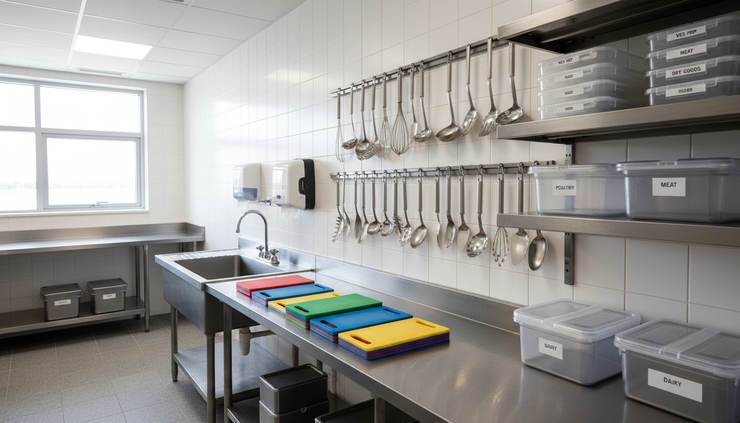
Cross-contact happens when an allergen transfers from one food, surface, utensil, or hand to another. This can happen even when the allergen is not an ingredient in the meal itself.
Common examples include:
Risk point | Safer control |
One serving spoon used for several dishes | Use separate utensils for each dish |
Bread crumbs on a preparation surface | Clean surfaces before preparing allergen-safe meals |
Staff changing tasks without washing hands | Build handwashing into food service routines |
Similar-looking meals placed together | Use clear labels or a separate holding area |
Substituted ingredients from a supplier | Check labels before service begins |
Cross-contact controls do not have to be complicated, but they do need to be consistent. A rule followed only on quiet days is not a safety system.

Training turns policy into action
A written policy only protects children if staff know what to do. Benedict Law discussions often focus on training because allergy safety depends on decisions made in real time.
Training should cover both prevention and emergency response.
Food service training
Catering teams and lunchtime staff need practical guidance on:
Reading ingredient labels
Checking changes to recipes or suppliers
Avoiding cross-contact
Serving the correct child the correct meal
Keeping allergen information accessible
Recording concerns or near misses
This training should be repeated often enough for new staff and temporary staff to understand the system. Schools should not assume that a supply worker or agency caterer knows the local process.
Whole-school awareness
Allergy safety is not only a kitchen issue. A pupil may react in a classroom, playground, coach, sports hall, or after-school club.
Staff across the school should understand:
What an allergic reaction can look like
When to call for emergency help
Where medication is kept
Who leads during an incident
How to communicate with families after an event
Younger children may not describe symptoms clearly. They might say their mouth feels funny, their throat feels tight, their tummy hurts, or they feel strange. Staff should treat unusual symptoms seriously when a known allergen risk exists.
Emergency medication procedures
Some pupils are prescribed adrenaline auto-injectors. Schools should have clear rules on storage, access, expiry checks, and use. In places where schools may hold spare auto-injectors, they must follow local requirements and parental consent rules.
Emergency procedures should be direct and visible to trained staff. During a severe reaction, confusion costs time.
A good plan answers these questions:
Who gets the medication?
Who stays with the child?
Who calls emergency services?
Who meets paramedics at the entrance?
Who contacts the family?
Who supervises the rest of the class?
The safest emergency plan is one that staff can follow quickly on the worst day, not one that looks impressive on paper.
Benedict Law should connect food safety with inclusion
A strong allergen policy is not only about avoiding legal risk. It also affects whether children can take part in school life.
Food appears in many school activities:
Lunches and snacks
Breakfast clubs
Cooking lessons
Fundraising events
Cultural celebrations
Sports days
Rewards and class treats
Residential trips
If allergy planning covers only the canteen, gaps remain. Pupils with allergies should not be excluded from normal school experiences because the adults did not plan ahead.
This is where food safety and inclusion meet. Schools can often make small changes that reduce risk without isolating the child.
For example:
Use non-food rewards where possible
Ask families before bringing food into class
Choose shared activities that do not rely on allergens
Plan safe alternatives for cooking lessons
Check trip venues and packed meal arrangements early
Give catering teams notice before events
In the UK, schools may also need to consider equality duties where a child’s allergy or related condition amounts to a disability. This does not mean every risk can disappear, but it does mean schools should make reasonable, practical adjustments where needed.
The best approach avoids two extremes. Schools should not treat allergic pupils as a burden, and they should not minimise serious medical risk. A well-run system lets children join in with confidence.
What school leaders and families should look for
Whether Benedict Law is being discussed as a legal reform, a local policy, or a campaign for stronger protections, the practical test is the same. Does the school’s system work when food choices change, staff are busy, and children are moving around?
A school can review its approach by asking a few plain questions.
Are responsibilities clear?
Someone should own each part of the process. That does not mean one person does everything. It means everyone knows their role.
Area | Who needs to be involved |
Allergy records | Families, school office, pastoral staff, class teachers |
Menu planning | Caterer, school leadership, families where needed |
Food service | Kitchen staff, lunchtime supervisors |
Classroom food | Teachers, teaching assistants, parents and carers |
Medication | Designated trained staff, senior leaders |
Trips and events | Trip leaders, venue staff, families, caterers |
When roles are vague, safety depends on luck. Clear ownership makes mistakes easier to prevent and easier to correct.
Are changes communicated quickly?
Food safety systems often fail when something changes. A supplier replaces a product. A recipe changes. A pupil develops a new allergy. A staff member leaves. A class party gets arranged at short notice.
Schools need a simple route for updating information. Families should know who to contact. Staff should know where the latest records are kept. Caterers should have a rule that no substitution reaches a pupil with allergies until the ingredients have been checked.
Are near misses recorded?
A near miss is a warning sign. It might be a wrong meal placed on a tray but caught before the child eats it. It might be missing allergen information for a new snack. It might be medication stored in the wrong place.
Near misses should not be buried out of embarrassment. They should be recorded, reviewed, and used to fix weak points.
A useful review asks:
What happened?
Where did the system fail?
Who needs to know?
What will change?
How will the change be checked?
This keeps the focus on learning, not blame.

The key takeaway for safer school food
Benedict Law Food Safety and Allergen Protections in Schools is best understood as a call for dependable systems. The name matters less than the standard it points to: children should not have to rely on chance, memory, or last-minute improvisation to eat safely at school.
The strongest schools do a few things well. They keep allergy records current. They train staff beyond the kitchen. They check ingredients every time food changes. They control cross-contact. They plan for trips and classroom events. They respond to emergencies with speed and clarity.
This article is general information, not legal advice. Schools and families should check the rules that apply in their own area and seek qualified advice where a specific legal duty or medical plan is in question.
The practical next step is simple: choose one meal service, one classroom activity, or one upcoming trip and trace the allergen safety process from start to finish. If a gap appears, fix it before the next child depends on it.


Comments